Thursday, April 17, 2008
Soulless Body
Many years ago, I had memorised the famous poem by H.W.Longfellow, "The Psalm of Life", which has these lines, “Life is real! Life is earnest! And the grave is not its goal; Dust thou art, to dust returnest, Was not spoken of the soul.”.
Life is indeed a mystery, but to answer our "basic doubts", do we really need to take recourse to the ethereal spirit, in a "material" body? This spirit, we call the "soul" or "आत्मा atma" ,(described succinctly by Emily Dickinson, in her poem "The Spirit"). And is it true that the soul survives the body? Almost all religions say so! The Bhagwat Gita, has these famous lines in Chapter II
"The soul which resides in every being, is indestructible. Who then can destroy this indestructible soul?
Soul is never born-nor ever dies. It is unborn, permanent, eternal and never dies when the body is killed.
Who can kill the soul and how can one kill the soul when the soul is indestructible, unborn and forever un-destroyable.
Just as humans renounce old dresses and put on a new ones, a soul renounces the old body and takes a new one.
Weapons cannot cut it, fire cannot burn it, water cannot soak it, nor wind can dry it.
Un-cuttable, un-burnable and un-soakable, un-dryable; the eternal soul is omnipresent, permanent and unchanging."
It is indeed superfluous to believe in the soul. In fact disbelieving in a soul, solves many an existential issue. For one, death ends everything. On death we just get recycled into the very same material which formed us . "Dust thou art to dust returnest", indeed rings true. There is a lovely song in Marathi, "माती सांगे कुम्भाराला पायी मज तुडवीसी तुजाच आहे शेवट वेड्या माज्या पायाशी , translated it says "the clay warns the potter, 'you are now kneading me with your feet, but remember, your end is ultimately at my feet' ". What happens to the body after death makes no difference to the dead as the body is entirely sans feelings. Good and Evil are just two different perspectives, which are highly subjective, and time and space relevant. Neither can we have just a "Black" and a "White", there is a lot of "Grey" in between. Believing in a "Ledger" of good deeds (पुण्य) and bad deeds (पाप) , and in divine justice of the "Ledger Keeper", is naive, to say the least. If "Truth" implies "What is", it has to be subjective, as it depends on the perception spectrum of the observer. When neither space nor time can be absolute, the very frame work for defining reality is on shaky grounds.
To sum up, instead of living through life, with the belief of a greater happiness after life, let us try to be happy "now" and "here", and in doing so, try our level best not to make others (which includes everything living) unhappy.


Sunday, March 30, 2008
Till Death Do Us Part!!

This morning on my usual walk, I came across the small "Mhasoba" shrine on the way. I was reminded of an incident which took place a year ago at this very place.
That morning I had set out a little earlier than usual. Though the visibility was low, I could easily discern objects. This stretch of road is uninhabited, with an occasional farmer or labourer crossing my path. I love the solitude as it gives me the opportunity to be with myself. As I came up to the shrine, I saw a moped parked just near the step. A couple of pair of sandals had also been left there. I distinctly remember wondering as to who should have come to the shrine at that early an hour, specially as no one was in sight. I thought maybe the couple had gone to have a dip in the reservoir nearby, and proceeded on my walk. On my way back, it was fairly bright, while at the same spot, I heard a sound of muted wails, my dogs accompanying me, started barking in frenzy. I could not help but walk in the direction of the sound, and Lo! just behind the shrine, a young couple was lying in the slush. The man was stiff and obviously dead, but the women was gasping. I turned her over to find that her pupils were dilated and she had froth around her mouth. There was a half empty can of insecticide near the place. I, immediately called the police from my cellphone. I also phoned up my driver to get the car, which arrived before the police. With the help of some passers by, we managed to put her in the car. We took her to Sangli Civil Hospital, as this was a medico-legal case which no private medical practitioner would touch. In spite of every effort to save her, the women did not regain her consciousness, and succumbed to the poison a few days later.
During the police investigations, a diary was recovered near the place, the man had written, that no one should be blamed for their suicide. Bit by bit the whole story came out.
The young man had settled in Mhaisal since the past six years. He was staying with his mother, wife and two children. He was a competent mechanic and was an expert of sorts, in the fabrication of "boats" required for the extraction of sand from the river bed. The young women, hailed from Pandharpur, and came from a decent family. Unfortunately she had a very troubled marriage, and had run away from her drunkard husband, who would incessantly torture her. She too had made Mhaisal her home. Initially she tried to sustain herself by working in the farms, but soon she fell prey to the nefarious designs of her employer. After some time she was again discarded. At this juncture she met our mechanic lad, and the couple fell madly in love. Soon both of them realised that society in general and his family in particular, would not accept their living together. They felt, they could find bliss in death, which they could not hope to attain in life. This had prompted them to take the extreme step.
I don't know what happens when people die, but at least they are relieved from the bondage that life is all about.
Wednesday, February 20, 2008
25 th. Wedding Anniversary
As 2008 set in, I realised, I had been married to Varsha, for 25 years. It seemed only yesterday that we had tied the knot, and memories of the long years we had spent together came gushing through . Our's was an arranged marriage, and I had met her only once before the D'day. I would some times speak with her on the telephone though. I had even sent her a few letters after our engagement, which by no stretch of imagination could be construed as 'love letters'. Our wedding was attended and blessed by Yashwantrao Chavan (Varsha's grandfather). It was one big public function, lasting over a week, meticulously planned, by my uncle Late Mohanrao Shinde. The wedding feasts were handled by my eldest uncle, Late Kishorsing Shinde. As my father was no more, my youngest uncle, Appasaheb & aunty Rohini, performed all the "Vidhis".
The 25 th. Anniversary was on the 10 th. of Jan. 2008, but we decided to have the party on the 26th. Jan. taking into consideration the convinience of all our friends and relatives.


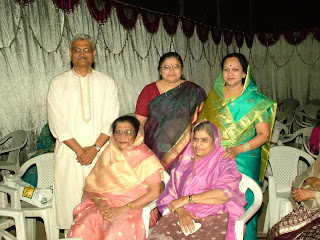
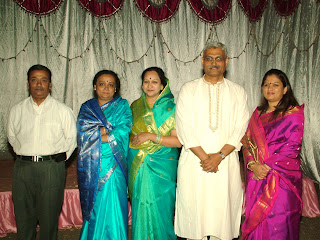

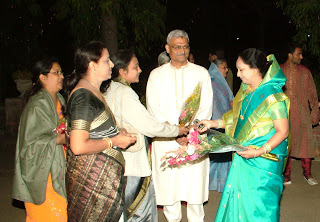


The 25 th. Anniversary was on the 10 th. of Jan. 2008, but we decided to have the party on the 26th. Jan. taking into consideration the convinience of all our friends and relatives.

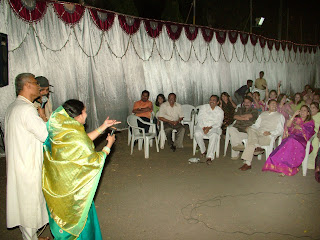
We had decorated our Bunglow facade, with a lot of "running lights". The climate was a bit chilly so we had lit bonfires. We had arranged for 'live' music, playing mostly nostalgic Kishor Kumar, and Mohamad Rafi, numbers. Guests started arriving by 7 PM and it was past midnight, by the time the last guests departed. Almost all members of our extended family and some close friends and colleagues attended. Shri. Jayantrao Patil, to whom my cousin Shailaja is married and Shri. Satyajit Deshmukh, to whom my other cousin Renuka is married too attended. My friend and Brother-in-law, Ajit Suryavanshi, to whom Anija, my cousin is married was also there. Amongst my friends, Shri Vinod Digrajkar, Phaltane, Kashikar, Satpute, Maniyar, Saudatti, Anil Kulkarni, and many others were present. All of us enjoyed the 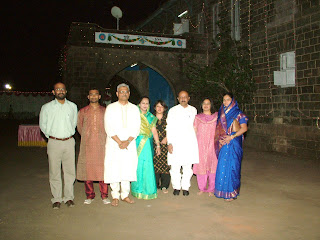
 evening immensely.

 evening immensely.


Sunday, February 3, 2008
"Bhandarkhana"

Mhaisal being on the boundary between Maharashtra & Karnataka states, enjoys a unique blend of cultures, of North and South India. This beautiful interweaving of cultures is reflected in the festivals that are celebrated.
"Renuka" the embodiment of "Shakti", and venerated as "Adimaya", has her seat at "Saundatti", in Belgaum Dist. of Karnataka. She is worshipped in North Karnataka, and South Maharashtra, as "Yellamma"(every one's mother, in Kannada), with many temples dedicated to her.
One of the many festivals in her honour is the "Bhandarkhana", which is essentially, 'breaking bread', together without distinction of class, creed, caste or relegion.
My uncle, late Kishorsing Shinde, was one of Her ardent devotees, he started the Bhandarkhana in our village on a grand scale over Thirty Six years ago. At it's peak, over 12,000 people participated. It was said that on the Bhandarkhana day, not a single hearth was stoked in the village, as every one would partake of the common meal as prasad.
The preparations begin at least ten days before the Poornima (full moon day), in the month of "Poush", of the Hindu, lunar calendar. Many send in their offerings, in the form of money, wheat, Sugar/Jagery, and other stuff. There is a panch committee,(presently headed by my cousin, Kailassing), which o versees all the preparations. The actual cooking starts very early in the morning. The Kheer ( a sweet gruel of Wheat ,Jaggery and added flavours) is prepared in huge vessels called a "Kail" .
In the morning the "Aarti" (invocation and praise of the Deity) is performed. Then the "Pangats" start. The first serving goes as a "Nevedya"(offering) to the Goddess, and then the "Jogtins"("Devdasis", these women are fortunately becoming rarer by the day, and will eventually disappear), are fed, with a lot of respect. It is indeed interesting to see the richest and poorest, the upper castes and the lower ones, Hindus and Muslims, all sit together and share the same simple fare, with piety and humility.
 A real portrayal of "Sarva-Dharma-Samabhav" (True Indian Secularism)
 that are celebrated.
"Renuka" the embodiment of "Shakti", and venerated as "Adimaya", has her seat at "Saundatti", in Belgaum Dist. of Karnataka. She is worshipped in North Karnataka, and South Maharashtra, as "Yellamma"(every one's mother, in Kannada), with many temples dedicated to her.
One of the many festivals in her honour is the "Bhandarkhana", which is essentially, 'breaking bread', together without distinction of class, creed, caste or relegion.

My uncle, late
 Kishorsing Shinde, was one of Her ardent devotees, he started the Bhandarkhana in our village on a grand scale over Thirty Six years ago. At it's peak, over 12,000 people participated. It was said that on the Bhandarkhana day, not a single hearth was stoked in the village, as every one would partake of the common meal as prasad.
The preparations begin at least ten days before the Poornima (full moon day), in the month of "Poush", of the Hindu, lunar calendar. Many send in their offerings, in the form of money, wheat, Sugar/Jagery, and other stuff. There is a panch committee,(presently headed by my cousin, Kailassing), which o
 versees all the preparations. The actual cooking starts very early in the morning. The Kheer ( a sweet gruel of Wheat ,Jaggery and added flavours) is prepared in huge vessels called a "Kail" .
In the morning the "Aarti" (invocation and praise of the Deity) is performed. Then the "Pangats" start. The first serving goes as a "Nevedya"(offering) to the Goddess, and then the "Jogtins"("Devdasis", these women are fortunately becoming rarer by the day, and will eventually disappear), are fed, with a lot of respect. It is indeed interesting to see the richest and poorest, the upper castes and the lower ones, Hindus and Muslims, all sit together and share the same simple fare, with piety and humility.

 A real portrayal of "Sarva-Dharma-Samabhav" (True Indian Secularism)
Sunday, January 20, 2008
Abasaheb Shinde "Punyatithi"

It is Thirty Six years since my father Abasaheb passed away in a car accident, early morning on 20th. Jan. 1972. He was Forty Five. Just the day before he had been selected by the Indian National Congress Party, as a candidate to contest the Maharashtra State Assembly Elections. It was a dream come true for him as he had been denied the "ticket" a couple of times before. This time famous personalities like Dilip Kumar, and Yashwantrao Chavan had pitched for him. His election was a forgone conclusion, as the Miraj constituency he would be contesting from was a very strong INC stronghold.
I was just Fourteen then, and studying at Belgaum. I remember the day very vividly. My mother came to school at around 10 AM, and requested my teacher to allow me to leave with her. She had obviously not been told about the tragedy, she just knew there was an emergency and we were to go to Mhaisal. The moment we reached, home, the impact of the happenings, hit us like a tornado. My father's body was brought in a long concierge, after a procession both in Miraj and Sangli, where (we were told later) people went into a deep mourning. I remember touching his feet, and being surprised at their coldness. By convention, I should have creamated him, but my family felt I was too young to do so.
A lot of time has elapsed since, but the loss is still acutely felt by not just his family, but by many whose life he touched, throughout the Sangli District. Today his statue stands in Kisan Chowk at Miraj (which was innaugarated by Dilip Kumar, Yashwantrao Chavan & Vasantrao Dada Patil, in 1975). His busts have been installed at Sangli & Mhaisal. A Memorial also stands at the exact spot of his accident near Digraj (Sangli). A road in Miraj and a Square has been named after him by the Muncipal Corporation.

To me he will always be an idol, whom I will try my best to emulate.
Thursday, January 17, 2008
"Soham"
Early every morning, my grandmother or mother, would draw 'Rangoli' on our doorstep.
We as children, still not fully awake, would sit on the steps yawning, and observing the intricate shapes materialise from the thin stream of the 'rangoli' powder flowing between their thumb and fore finger. The patterns they drew, though from memory, were quite intricate. Some times they would be straight geometric, and at others curvaceous. Some times they would first create a grid, and at other times they would do without one. If they felt particularly happy, they would draw a curvaceous stem with a couple of leaves and a lovely flower. Sometimes the flower would be a rose, at other times it would be a "Jaswand", and some times off course a purely imaginary one. The rangolis were rarely coloured, even when they were, they were done so, with only light colours used sparingly. After the drawing had been accomplished, they would invariably write a word or phrase below the 'Rangoli', most of the times it would be an invocation to the various Hindu deities, but some times a phrase like “Soham” or “Om Tat Sat”, would be written. We convent educated brats hardly had an inkling of the profundity of it's meaning. I, once asked my grandmother, what it meant, the answer she gave, is still fresh in my mind. She explained that every thing around us was part of a whole, and that whole was itself Brahma (The Creator Himself). The whole "Cosmos" was "Bramhand" and "Brahma" and "Brahmand" are one and the same. She then told us the rationale of not inflicting pain on
any thing animate or inanimate, human or otherwise, as it would be like hurting oneself. She said that was the reason we did 'namaskar' (an obeisance), when accidentally our feet touched someone, or something as inanimate as a book, as that namaskar was not meant for that person,
or thing, but to the divinity within. This was in essence the philosophy of "Advaita"
Interestingly though Western Philosophy is 'materialistic' and 'dualistic', this concept of 'oneness' pops out sometimes through their literature. An example that comes to my mind is the poem
by Jone Donne,
"No man is an island, entire of itself .
Any man's death diminishes me, because I am involved in mankind;
And therefore never send to know for whom the bell tolls;
It tolls for thee.",
which was immortalised, when Hemmingway used the line “For Whom the Bell Tolls”, as a title for his lovely book.
In today's world, if we revert to the old teachings of "Oneness", We for sure, will all come out, winners.
Subscribe to:
Posts (Atom)